

Conditional sentences allow us to express possibilities, hypotheses, and outcomes, which are crucial for conveying complex ideas and making logical connections in both speech and writing.
Want to master conditional sentences? This blog breaks down their types, structures, and how to use them like a pro.

A conditional clause is a clause that sets a condition, often introduced by if or similar words or phrases. A sentence that contains a conditional clause is called a conditional sentence.
Examples:
♦ If it rains, we will stay inside.
♦ I will attend the convention if I am in town.
♦ I will take this book, if you please.

Related Reading: Using Subordinate Clauses Like a Pro
How to Form Conditional Sentences?
Conditional sentences have two main parts: an if clause (the condition) and a main clause (the result). These sentences help express a condition and its possible outcome. For example:
So, in the sentence If it rains, we will stay inside. The condition is If it rains, and the result is we will stay inside.
The order of the condition and conclusion is flexible and either could come first.
Another name for the conditional clause is protasis, and the conclusion is often called the apodosis.

Sentence Conclusions
The conclusion of a conditional sentence may be declarative, interrogative, imperative, or exclamatory.
Examples:
♦ If I see him, I will tell him. [Declarative]
♦ If you go to Philadelphia, where will you stay? [Interrogative]
♦ Sit here, if you want. [Imperative]
♦ If you win the prize, how happy I will be! [Exclamatory]
Types of Conditional Sentences
What types of conditional sentences are there? I’m so glad you asked.
Zero Conditional
We use zero conditional sentences to talk about facts and general truths, where the result is always true when the condition is met.
♦ Example: If water reaches 100°C, it boils.
First Conditional
First conditional sentences describe real and possible situations in the future.
♦ Examples: If it rains tomorrow, we will stay inside.
Second Conditional
We use second conditional sentences for hypothetical or unlikely situations.
♦ Examples: If I won the lottery, I would travel the world.
Third Conditional
Third conditional sentences explore unreal past events and their hypothetical outcomes.
♦ Examples: If I had known about the meeting, I would have attended.
Mixed Conditional
Basically, mixed conditionals connect what happened in the past to what’s happening now.
♦ Example: If I had studied harder, I would be more confident now.

Variations and Complex Structures
Let’s discuss the variations and complex structures.
Alternative Introductions
You can start an if sentence with words like provided, granted, supposing, or on condition that.
♦ Example: I will let you go, on condition that you come home early.
♦ Example: You can have the money, if you put it in the bank.
Negative Conditions
We commonly introduce a negative condition by if … not or unless.
♦ Example: I will wait for him, if you do not object.
♦ Example: Unless you overcome that habit, you will be in trouble.
Double Conditions
We can introduce double (or alternative) conditions by whether … or.
♦ Example: Whether he goes or stays, he must pay his rent. (Compare: If he goes or if he stays, etc.)
♦ Example: He is determined to buy that car, whether or not you approve. (That is: if you approve or if you do not approve.)
Compound Words
Whoever, whenever, or some similar compounds can introduce a conditional clause.
♦ Example: Whoever offends, is punished. [Instead of: If anybody offends, they are punished.]
♦ Example: She will come whenever [= if ever] she is called.
Omitted Elements
Conditional clauses can sometimes omit the copula (linking verb) and its subject.
♦ Example: I will go if [it is] necessary.
♦ Example: If [it is] possible, come tomorrow.
The if-clause can also appear as standalone exclamations (with the conclusion omitted).
♦ Example: If I only had a car!
Complex Conditions
We can express conditions using assertions, questions, or commands.
♦ Example: Press the button, and the bell will ring.
♦ Example: We will sail on Monday, weather permitting.

Forms of Conditions
Conditional sentences can be super tricky, but you can easily group them by when things might happen and how sure the speaker is. Conditions may be present, past, or future.
Present and Past Conditions
Present and Past Conditions can be non-committal or contrary to fact.
Non-committal
A condition is non-committal when it implies no certainty about the truth
♦ Example: If James is angry, I am sorry. [Maybe James is angry, maybe not.]
Contrary to Fact
A condition is contrary to fact when it implies that the supposed case is not or was not true.
♦ Example: If James were angry, I should be sorry. [James is not angry.]
Future Conditions
Future conditions always imply some doubt, as they refer to events that have not occurred yet.
♦ Example: If it rains tomorrow, I won’t go.

Related Reading: Exploring Adverbs: Types, Examples, and Uses
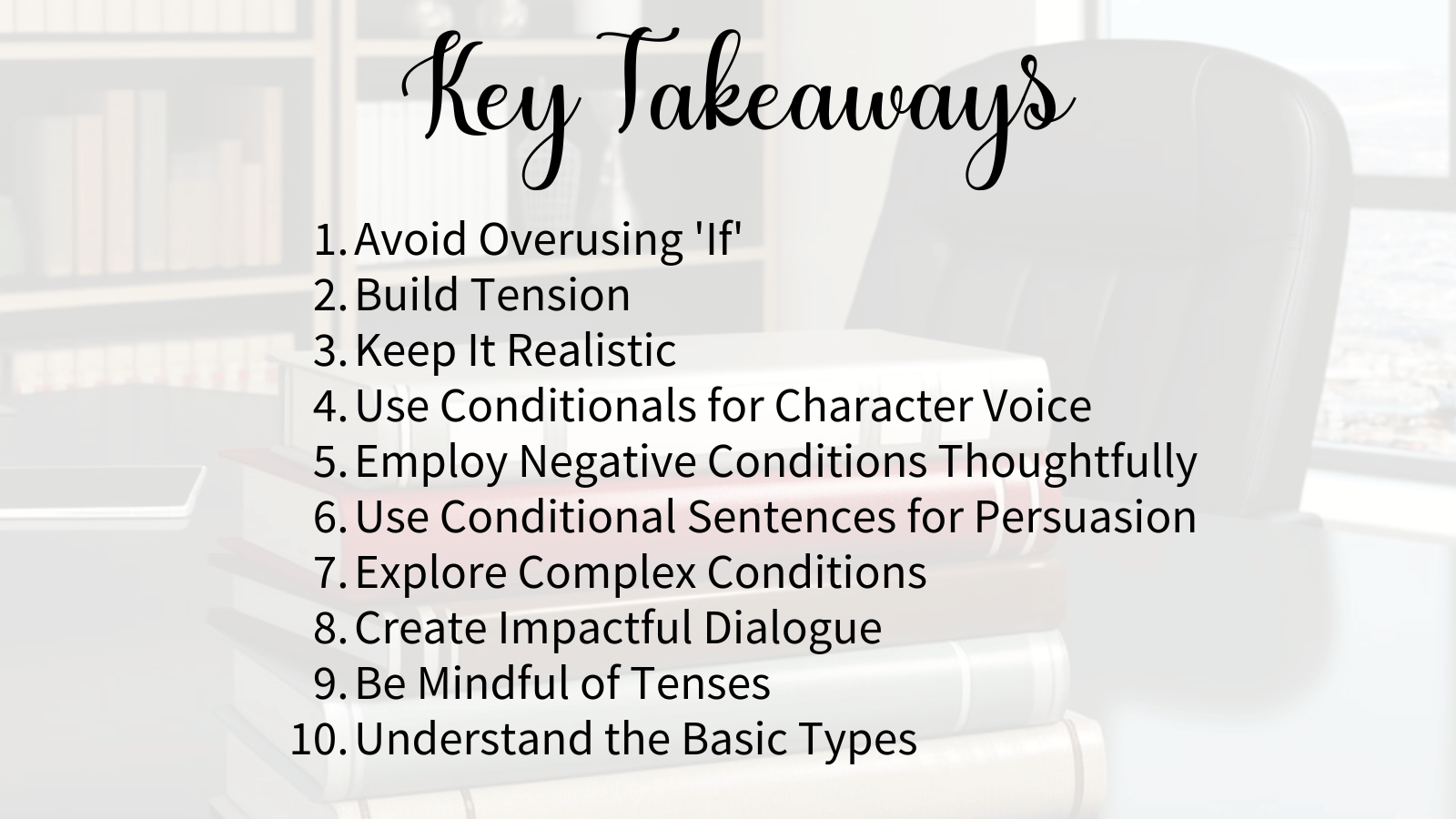
Key Takeaways
1. Avoid Overusing ‘If’: Explore alternative introductory phrases like provided that, supposing, or on condition that to diversify your language.
2. Use Conditional Sentences to Build Tension: Employ conditionals to create suspense or foreshadowing in your narrative.
3. Keep It Realistic: Ensure your hypothetical scenarios are believable to maintain the reader’s engagement.
4. Use Conditionals for Character Voice: Reflect a character’s personality or thought process using different types of conditionals.
5. Employ Negative Conditions Thoughtfully: Use unless or if … not strategically to introduce contrast or alternative outcomes.
6. Use Conditional Sentences for Persuasion: Leverage conditionals to persuade or argue a point effectively
7. Explore Complex Conditions: Introduce clauses with whether … or or whoever to add depth and sophistication.
8. Create Impactful Dialogue: Use conditionals in conversations to convey a character’s intentions, plans, or doubts.
9. Be Mindful of Tenses: Ensure the correct pairing of tenses in both the condition and the result clause to maintain grammatical accuracy.
10. Understand the Basic Types: Familiarize yourself with zero, first, second, third, and mixed conditionals to use them effectively in your writing.
Last Words on Conditional Sentences
Whether you are explaining causes, contrasting ideas, or stating conditions, subordinate clauses are powerful tools that give your writing greater depth and clarity.
Happy writing!
Linda

Liked this post? Pin this image! It’s a huge help for my blog. Thank you!
Feature Image by This_is_Engineering from Pixabay.


0 Comments