

Have you ever read a sentence that made you stop and say, “Wait… what?” Sometimes a writer chooses a word that sounds right, despite being incorrect. That kind of mix-up is called a word impropriety.
In this blog, we’ll look at what word improprieties are, why they matter, and how to avoid them in your writing.

Misusing a word—choosing one that’s inappropriate for the context, tone, or meaning—is a word impropriety. In other words, the use of a proper word in an improper sense.
It’s not a spelling mistake. It’s more like using a screwdriver when you really need a hammer. The tool might look okay at first, but it won’t do the job. Many errors stem from words that sound, look, or mean similar things.
Note: a barbarism (using words wrong), a solecism (violations of the principles of grammar) and an impropriety, somewhat overlap one another.
Related Reading: The Power of Word Choice

Why Improper Word Choice Hurts Your Writing
The wrong word choice can confuse your audience, damage your credibility, and undermine your communication.
♦ Example:
Wrong: He was very disinterested in the movie.
Right: He was very uninterested in the movie.
Disinterested means neutral—not bored. So, the wrong word changes the meaning completely.
Related Reading: Mastering Sentence Structure
Common Types of Word Improprieties
Let’s look at some categories where these mix-ups happen a lot.
Wrong Word for the Meaning
Picking the wrong word when you meant something else.
♥ Accept (to take) vs. Except (to leave out)
♥ Effect (noun) vs. Affect (verb)
♥ Compliment (a nice word) vs. Complement (goes well with)
♦ Example:
Wrong: The dessert wine was the perfect compliment to the meal.
Right: The dessert wine was the perfect complement to the meal.
Misused Idioms or Phrases
Some sayings get twisted over time.
♦ Example:
Wrong: For all intensive purposes
Right: For all intents and purposes.
Related Reading: Classifying Sentences
Overly Fancy or Outdated Words
Using overly formal language can make your writing sound unnatural.
♦ Example:
Wrong: She commenced to commence the preparation of dinner.
Right: She started making dinner.
Wrong Tone or Register
Some words are too casual for formal writing, and some are too formal for casual pieces.
♦ Example:
Wrong: (In a job application) Yo, I’m super pumped to work here!
Right: I’m very excited to apply for this position.
Sound-Alike Words (Homophones)
Words that sound the same but have different meanings cause trouble all the time.
♥ Their / There / They’re
♥ Principal (school leader) / Principle (rule or value)
♥ Your / You’re
♦ Example:
Wrong: The principal of kindness is important.
Right: The principle of kindness is important.
Related Reading: Sentence Types Made Simple
More Examples of Word Impropriety
Here are a few quick ones to watch out for:
Accept vs. Except
Accept = to receive
Except = to leave out
Sound alike, but mean the opposite.
Aggravate vs. Irritate
Aggravate = to make worse
Irritate = to annoy or bother
People use aggravate when they really mean irritate.
Allude vs. Mention
Allude = to hint at
Mention = to say directly
One is indirect, the other is clear.
Allusion vs. Illusion vs. Delusion
Allusion = a reference to something
Illusion = a false appearance or trick
Delusion = a false belief
All sound similar, but they mean: reference, trick, belief.
Argue vs. Augur
Argue = to disagree
Augur = to predict
Sound similar but are totally unrelated in meaning.
Avocation vs. Vocation
Avocation = hobby
Vocation = job or calling
Look alike; one’s for fun, one’s for work.
Besides vs. Beside
Besides = in addition to
Beside = next to
The “s” makes a big difference in meaning.
Calculate vs. Intend
Calculate = to figure out
Intend = to plan or mean to do
Mistaken when calculate is used for thinking ahead.
Character vs. Reputation
Character = who you truly are
Reputation = what others think of you
Often confused because both relate to personal traits.
Claim vs. Assert
Claim = to state (may not be true)
Assert = to state confidently
Claim can sound doubtful; assert is stronger.
Council vs. Counsel vs. Consul
Council = group of people
Counsel = advice or a lawyer
Consul = government official
All sound alike but mean very different things.
Creditable vs. Credible
Creditable = worthy of praise or respect
Credible = believable or trustworthy
One is about honor; the other is about truth.
Effect vs. Affect
Effect = result (noun)
Affect = to change (verb)
Easy to confuse because both deal with change.
Emigration vs. Immigration
Emigration = leaving a country
Immigration = coming into a country
Opposite directions—easy to mix up.
Exceptionable vs. Exceptional
Exceptionable = likely to cause objection
Exceptional = outstanding, above average
Exceptionable is negative, exceptional is positive.
Evidence vs. Testimony
Evidence = facts or proof
Testimony = spoken or written statement (usually in court)
Evidence includes testimony, but they are not the same thing.
Good vs. Well
Good = adjective (describes a noun)
Well = adverb (describes an action)
Confused in phrases like I feel good vs. I feel well.
House vs. Home
House = the building
Home = where you live and feel safe
Similar but home has emotional meaning.
Human vs. Humane
Human = a person or relating to people
Humane = kind, compassionate, gentle
Human = who we are; humane = how we act.
Identity vs. Identification
Identity = who you are
Identification = proof of who you are (like an ID card)
Identity is the person; identification shows it.
Let vs. Leave
Let = to allow
Leave = to go away or put something down
Mistaken when someone says leave me do it instead of let me.
Like vs. As
Like = similar to
As = in the way that
Like is for nouns; as is for actions or clauses.
Likely vs. Liable vs. Probably
Likely = probably going to happen
Liable = legally responsible
Probably = almost certainly
Liable gets misused when people mean likely.
Limit vs. Limitation
Limit = a boundary or maximum
Limitation = a weakness or shortcoming
Limit is a rule or line; limitation is a flaw or restriction.
Loan vs. Lend
Loan = the thing (noun)
Lend = the action (verb)
Confused when people say can you loan me instead of lend me.
Mad vs. Angry
Mad = mentally unwell (traditionally); now also means angry (in casual speech)
Angry = upset or mad
Mad is informal and sometimes unclear.
Most vs. Almost
Most = the majority
Almost = nearly
Swapped by accident when people mean nearly all.
Much vs. Many
Much = things you can’t count
Many = things you can count
Countable vs. uncountable nouns.
Near vs. Nearly
Near = close in space
Nearly = almost (in amount or time)
Sound similar, but nearly is an adverb.
Observation vs. Observance
Observation = watching or noticing
Observance = following a rule or tradition
Different meanings, same root word.
Prescribe vs. Proscribe
Prescribe = to recommend or order (like medicine or rules)
Proscribe = to forbid or ban
One tells you what to do (prescribe), the other tells you what not to do (proscribe).
Portion vs. Part
Portion = a share or slice of something
Part = any piece or section of a whole
Portion often refers to food or something divided equally.
Quite vs. Very
Quite = fairly or completely (depends on region)
Very = to a high degree
In British English, quite can mean somewhat but in North American English, it can mean completely.
Respectively vs. Respectfully
Respectively = in order
Respectfully = with respect or politeness
Swapped when people mean one but use the other.
Sensible vs. Sensitive
Sensible = wise, practical
Sensitive = easily affected (by feelings, pain, etc.)
One is about thinking clearly, the other is about feeling deeply.
Solicitation vs. Solicitude
Solicitation = asking for something (like money or support)
Solicitude = care or concern for someone
Sound alike, but solicitation is a request, while solicitude is a feeling.
Suspect vs. Expect
Suspect = think something bad might happen
Expect = think something will probably happen
Suspect often has a negative feeling.
Teach vs. Learn
Teach = give knowledge
Learn = receive knowledge
People say “I taught myself” correctly but mix up “I learned them” instead of “I taught them.”
Transpire vs. Happen
Transpire = to become known or revealed
Happen = to occur
Transpire is often misused as a fancy version of happen.
Related Reading: Complex and Compound-Complex Sentences
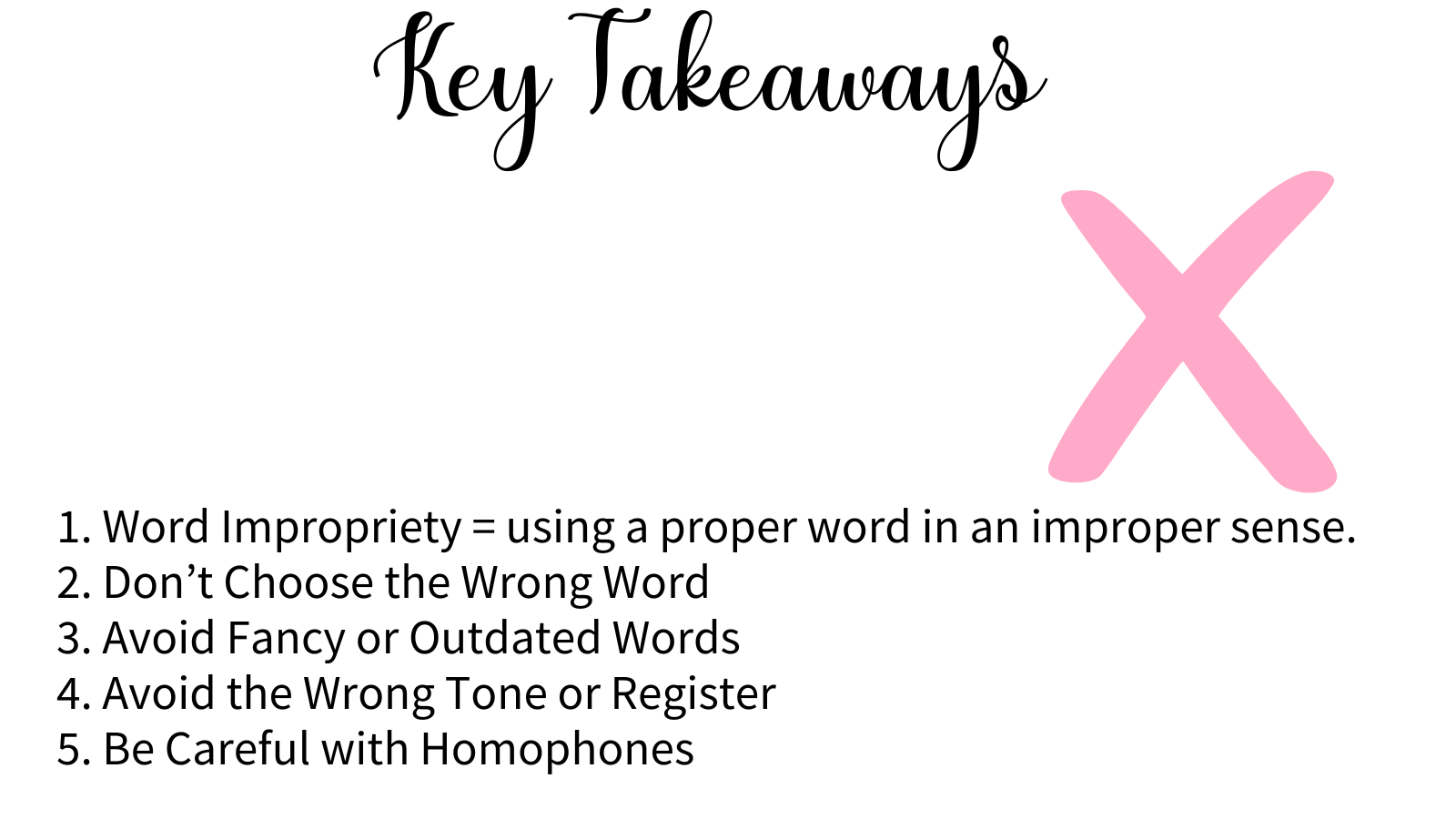
Key Takeaways
1. Word Impropriety = using a proper word in an improper sense.
2. Don’t Choose the Wrong Word: it can change the meaning of the sentence completely.
3. Avoid Fancy or Outdated Words: Using formal language can make your writing sound unnatural.
4. Avoid the Wrong Tone or Register: Some words are too casual, others too formal.
5. Be Careful with Homophones: Words that sound the same but have different meanings cause trouble all the time.
Last Words on Word Impropriety
Words matter. The right word can paint a picture, stir a feeling, or explain an idea clearly. The wrong word can leave readers confused or bored. As a writer, your job is to pick the best words you can. Keep it simple. Make it clear. Choose words that match your message.
Happy writing!
Linda
Liked this post? Pin this image! It’s a huge help for my blog. Thank you!
Feature Image by Deborah Hudson from Pixabay


0 Comments