

Once you understand what a sentence is, the next step is learning about the four sentence types. Each one has a different job. Some give information. Some ask questions. Others give commands or show strong feelings. The more kinds of sentences you use, the better your writing will be.

Let’s refresh. A sentence is a group of words that forms a complete thought, conveying a specific idea, message, or action.
Let’s look at each sentence type.

Declarative Sentences
A declarative sentence states a fact or gives information. This is the sentence we use the most or is the most common kind.
Examples:
♦ The sun is shining.
♦ I like chocolate cake.
♦ Writers need practice to improve.
Declarative sentences always end with a period.
Related Reading: Mastering Sentence Structure
Interrogative Sentences
Interrogative sentences ask a question.
Examples:
♦ What time is it?
♦ Do you like mystery novels?
♦ Where did you put my keys?
Interrogative sentences always end with a question mark.
Imperative Sentences
Imperative Sentences give directions or commands. They tell someone what to do. These can be friendly suggestions or firm orders.
Examples:
♦ Please close the door.
♦ Don’t forget your homework.
♦ Take a deep breath.
The subject is usually “you,” but it’s often left out. These sentences usually end with a period, but can end with an exclamation point if the command is urgent.
Exclamatory Sentences
Exclamatory Sentences show powerful emotion—surprise, excitement, anger, or joy.
Examples:
♦ What a beautiful view!
♦ That’s amazing!
♦ I can’t believe it!
These always end with an exclamation mark and should be used sparingly in formal writing.
Related Reading: Classifying Sentences
Understanding Sentence Style
The more you write, the more you’ll see how different sentences can feel. Some keep you guessing, others tell it like it is. Some are short and sweet, others are long and detailed.
There are three basic sentence types: periodic, loose, and balanced
Periodic Sentences
A periodic sentence holds the main idea until the end of the sentence. You have to read the whole thing before the full meaning is clear. Writers use this to create suspense or build toward something dramatic.
♦ Example: Although she was tired, hungry, and ready to give up, she kept going.
The main idea (she kept going) comes at the end. This kind of sentence makes the reader wait for the full message.
Related Reading: Why The Period Is So Important
Loose Sentences
A loose sentence gives the main idea right at the beginning, then adds more details afterward. This style is relaxed and conversational. You can end a loose sentence in multiple spots and still be understandable.
♦ Example: She kept going, even though she was tired, hungry, and ready to give up.
The core thought comes first, making it easy to understand right awa

Balanced Sentences
A balanced sentence has two parts that are similar in length and structure. It feels neat and even—almost like a scale with equal weight on both sides.
♦ Example: She wanted to stay, but she needed to go.
♦ Example: He works hard in silence; he celebrates in quiet.
Balanced sentences often sound poetic and are great for contrast or comparison.
Variety and Style
Do style and variety matter? Yes, they do!
Different Writing Styles
Different writing styles require distinct sentence types. In narrative writing, use descriptive sentences to immerse readers in your story. Persuasive writing benefits from varied sentence structures that emphasize key points. In informative writing, interrogative sentences engage readers by posing questions that lead to insights.
Why Sentence Variety Matters
Using different sentence types makes your writing more interesting and engaging. If every sentence sounds the same, your writing can feel flat or boring. But when you mix things up, your words come alive.
This paragraph has all four types – take a look.
♦ Example: I love writing stories. Do you enjoy writing too? Try writing for ten minutes every day. What a difference that makes!
See how each sentence feels different?
Sentence Classification
We classify sentence as simple, complex, and compound.
Simple Sentences
A sentence consists of a single statement.
♦ Example: The dog walks.
♦ Example: She reads a book.

Complex Sentences
A sentence comprising one principal clause (a complete thought) and one or more subordinate clauses (incomplete thought).
♦ Example: The horse that I saw is tall.
♦ Example: Although it was raining, they went for a walk.
Compound Sentences
A sentence with two or more clauses of equal importance connected by conjunctions expressed or understood.
♦ Example: The giraffe is tall and walks rapidly.
♦ Example: Watch the little things; they are important.
♦ Example: He likes coffee, and she prefers tea.
Related Reading: Complex and Compound-Complex Sentences
Key Takeaways
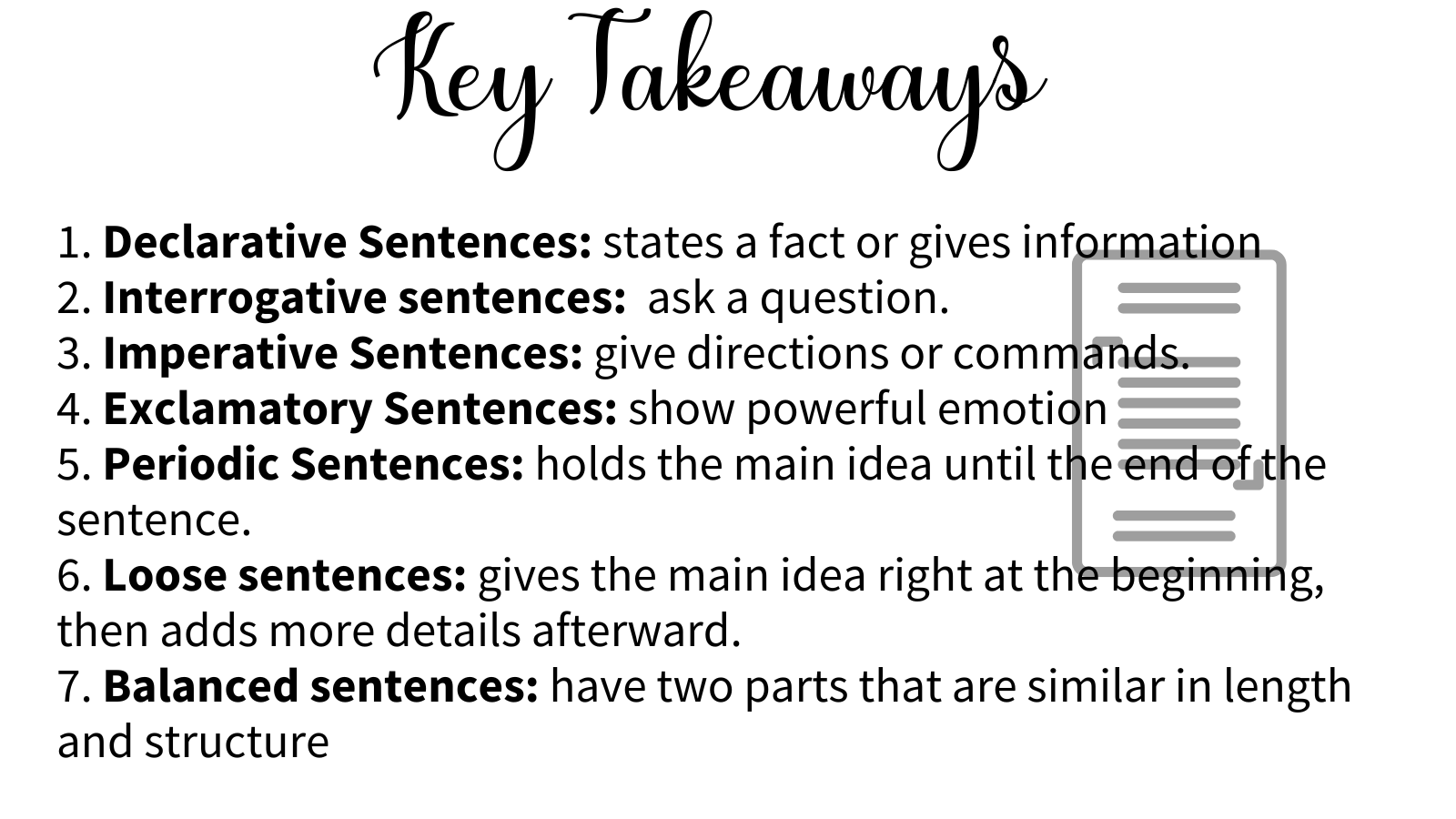
1. Declarative Sentences: states a fact or gives information
2. Interrogative sentences: ask a question.
3. Imperative Sentences: give directions or commands.
4. Exclamatory Sentences: show powerful emotion
5. Periodic Sentences: holds the main idea until the end of the sentence.
6. Loose sentences: gives the main idea right at the beginning, then adds more details afterward.
7. Balanced sentences: have two parts that are similar in length and structure
Last Words on Sentences
Each sentence type plays a special role. Some are calm and steady. Others are loud and energetic. When you know how to use them all, you give your writing power and personality.
Happy writing!
Linda

Liked this post? Pin this image! It’s a huge help for my blog. Thank you!
Feature Image by Katie Harp


0 Comments