

World-building can be one of the most enjoyable parts of writing.
It can also spiral into a giant rabbit hole.
You start by creating a town.
Then the town needs a history.
The history mentions an old war.
Now you need two kingdoms, three rulers, a trade route, a religion, a calendar, and a national dish.
Three weeks later, you have built a civilization.
You still have not written Chapter One.
That is the problem this method is meant to solve.
You don’t need to know everything about your fictional world before you start writing.
You need to know the parts that affect the story.
That is the whole idea behind the Only What You Need method.
Build what matters now.
Make a note of what may matter later.
Ignore the rest until the story asks for it.
There is nothing wrong with creating fun details.
♥ Maybe your fantasy kingdom once had twelve rulers in one century.
♥ Maybe your science fiction planet has three moons.
♥ Maybe everyone in your dystopian society wears blue on Founding Day.
♥ Maybe everyone has to wear the same colour shirts in your work place romance
Those details can be great.
But before you spend an hour developing them, ask: If I removed this detail, would the story change?
If yes, keep going.
If no, you can probably leave it alone for now.
Useful world-building affects what characters can do, what they believe, what they fear, and what problems they face.
♦ Example: In The Hunger Games, we don’t need every detail of Panem’s history to understand Katniss. We just need to know that the Capitol controls the districts, District 12 is poor, hunting outside the fence is illegal, and the Games are used as punishment and control. Those details matter because they shape Katniss’s choices.
That is story-supporting world-building.
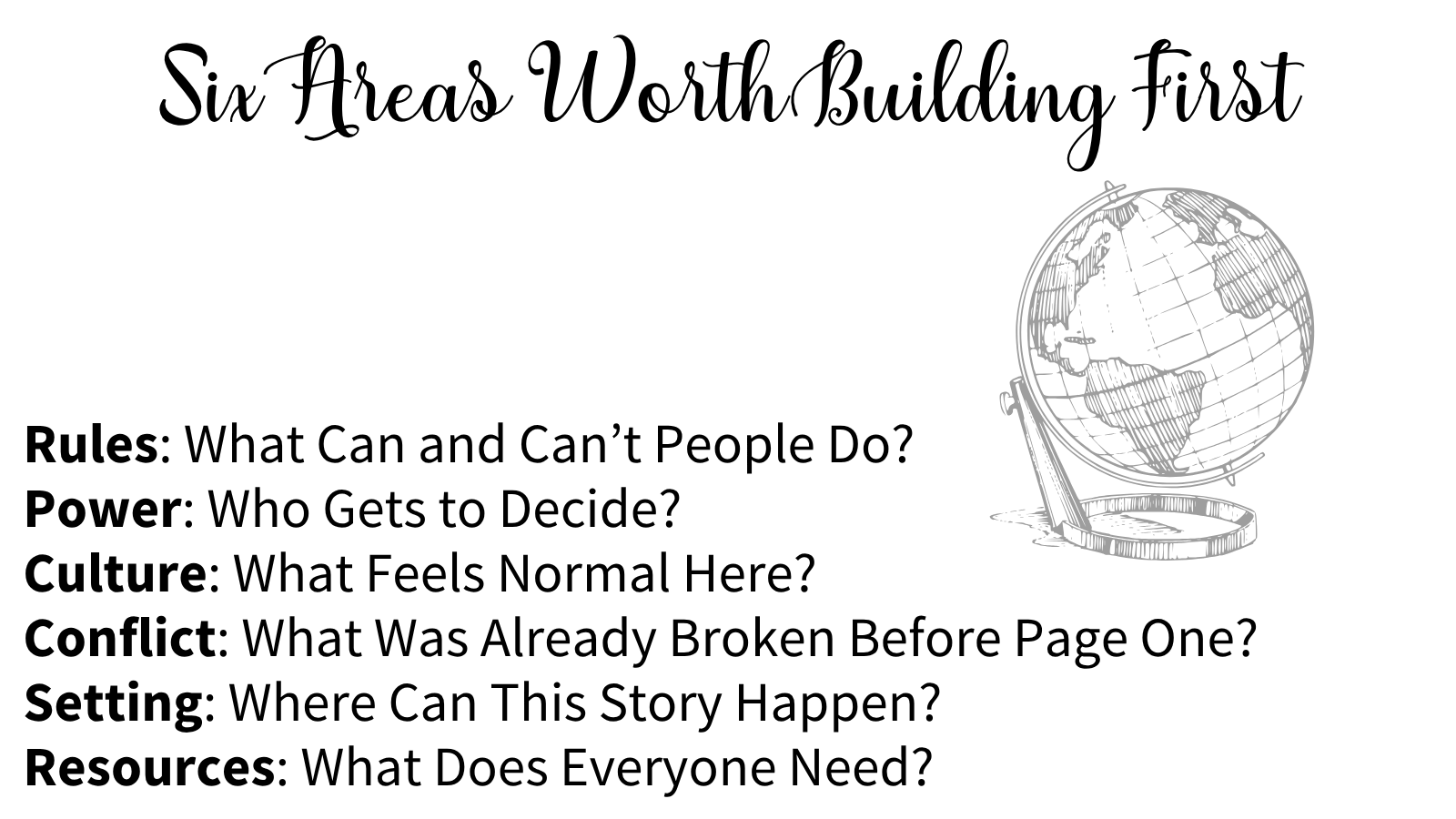
Six Areas Worth Building First
You can divide world-building into dozens of categories but most stories can get surprisingly far with six.
The trick is not to answer everything but ask what your story needs from each one.
Rules: What Can and Can’t People Do?
Every world has rules. Some are laws. Some come from magic, technology, religion, tradition, or social pressure. Rules matter because limits create choices and conflict.
Ask:
♥ What is allowed?
♥ What is forbidden?
♥ Who creates the rules?
♥ Who enforces it?
♥ What happens when someone breaks it?
If healing magic fixes every injury instantly, danger may not feel very dangerous. But if healing magic shortens the healer’s life every act of healing costs something. That is a useful rule.
The world rule creates the story problem.
♦ Example: In Divergent, people belong to factions based on certain values. The faction system shapes jobs, relationships, families, and identity. Tris’s problem begins because she does not fit neatly into that system.

Power: Who Gets to Decide?
Every society has people or groups with more power than others.
That power might belong to:
♥ A government
♥ A royal family
♥ Corporations
♥ Religious leaders
♥ Criminal organizations
♥ The military
♥ Magical groups
♥ Artificial intelligence
♦ Example: In The Maze Runner, the boys begin the story with almost no control over their situation. Someone else has placed them inside the Maze and controls much of what happens to them.
You don’t need a twenty-page political system. You just need to know how power touches your characters.
♥ Who gets what they want?
♥ Who does not?
♥ Who can punish whom?
♥ Who wants the system to change?
Power gets interesting when different groups want different things from it.
One group wants control.
Another wants freedom.
Someone else just wants to take over.
Now you have conflict.
Culture: What Feels Normal Here?
Culture tells you what people in the world take for granted. That can include food, family, education, religion, manners, clothing, celebrations, relationships, or taboos.
But the useful question is not: What customs exist?
It is: Which customs affect my characters?
♦ Example: In Dune, water matters culturally because water matters physically. On Arrakis, wasting water is not just rude. It can be dangerous.
Culture becomes more believable when it grows from the world itself.
Ask:
♥ What earns respect?
♥ What causes shame?
♥ What does everyone consider normal?
♥ What would an outsider find strange?
Those answers are usually more useful than inventing ten holidays nobody in the story attends.
Conflict: What Was Already Broken Before Page One?
This may be the most useful category of all. Your world should have problems that existed before the protagonist showed up.
♥ Maybe two groups hate each other.
♥ Maybe a war ended twenty years ago and nobody recovered.
♥ Maybe magic users have more rights than everyone else.
♥ Maybe robots are replacing human workers.
♥ Maybe resources are disappearing.
Your protagonist does not need to create the world’s problem. They just need to get tangled up in it.
♦ Example: Luke Skywalker does not create the conflict between the Empire and the rebellion in Star Wars. The world already has pressure in it which makes it feel larger than the protagonist.
Setting: Where Can This Story Happen?
Setting is more than a label because it changes what is possible.
♥ A town in open farmland creates one kind of escape.
♥ A town surrounded by mountains creates another.
♥ An island creates a completely different problem.
Think about climate, distance, transportation, geography, dangerous areas, and safe areas.
♦ Example: In Dune, the desert is not scenery. It affects survival, travel, clothing, culture, technology, and politics. That is what you want from setting.
Not just atmosphere but consequences.
Resources: What Does Everyone Need?
Resources create pressure fast.
♥ Food.
♥ Water.
♥ Medicine.
♥ Fuel.
♥ Money.
♥ Land.
♥ Information.
♥ Technology.
♥ Magical materials.
Ask:
♥ What does everyone need?
♥ Who controls it?
♥ Who gets more?
♥ Who gets less?
♥ What happens when it runs out?
Scarcity forces characters to act. If your protagonist cannot get something essential, you have a problem worth writing about.
♦ Example: In A Court of Thorns and Roses (Sarah J. Mass), food plays an important role because Fayre’s family often struggles to eat
Use Worldbuilding Triage
No need to do it all at once; just sort your ideas into three categories.
Build It Now
Develop anything that directly affects:
♥ The protagonist
♥ The opening chapters
♥ The main conflict
♥ Major rules
♥ Important locations
♥ Key factions
♥ Immediate plot events
If your protagonist gets arrested in Chapter Three, you probably need to know how arrests work. But, you don’t need the entire legal code.
Build It Soon
Some things matter later.
♥ Maybe the characters travel to another country in Act Two.
♥ Maybe an old war becomes important halfway through the book.
♥ Maybe a technology you barely mention now becomes central later.
Make a note, then come back when the story gets there.
Build It Later, or Maybe Never
Some details are fun but may never matter.
♥ Every king from the last thousand years.
♥ The childhood history of a character who appears twice.
♥ A complete economic model.
♥ Twenty regional recipes.
♥ A map of a country nobody visits.
Keep them if you love them, just don’t let them block the draft.
Look at the World Through Your Character
Your main character doesn’t know everything about their world, and neither do you about yours.
Most people cannot explain every law, government department, economic system, or historical event in their own country. I know I can’t so your characters should not have to either.
♦ Example: Thomas in The Maze Runner wakes up without most of his memories. That means readers learn about the world as Thomas does.
Ask:
♥ What do they understand?
♥ What do they take for granted?
♥ What scares them?
♥ What rules actually affect them?
♥ What do they not know?
That last question can be especially useful because ignorance creates mystery.
Readers don’t always need the whole world explained up front.
Sometimes they should discover it with the character.
Mini World-building Examples
Let’s take a look at how this could work in different genres.
A Quick Dystopian Example
Say your idea is: At sixteen, every citizen receives a career assignment they must keep for life.
You could spend months designing the society or you could build only what the story needs:
Rules: Changing careers is illegal.
Power: The government assigns jobs.
Culture: People believe your job determines your worth.
Conflict: Your protagonist refuses the assignment.
Setting: Neighborhoods are divided by job rank.
Resources: Higher-ranked workers get better housing and healthcare.
That is already enough to generate questions.
♥ Why did the protagonist refuse?
♥ What happens next?
♥ Can people move between classes?
♥ Who benefits from the system?
♥ Who wants it destroyed?
Now the world-building is doing something useful because it is creating story.

A Quick Fantasy Example
Try this: Magic works through written contracts.
You might decide:
Rules: A contract becomes magically binding once both people sign.
Power: Wealthy families control trained magical scribes.
Culture: Nobody signs important documents without witnesses.
Conflict: Someone discovers how to alter signed contracts.
Setting: Major agreements happen in protected contract halls.
Resources: The ink used for magic is becoming rare.
You don’t need five centuries of history yet. You already have enough to ask interesting questions.
♥ What happens if someone alters a peace treaty?
♥ A marriage contract?
♥ A royal command?
That is where story starts showing up.
A Quick Science Fiction Example
Imagine: Humans live on several planets, but only the wealthy can afford interplanetary travel. You could build:
Rules: Travel requires government approval.
Power: Corporations control transportation.
Culture: Wealthy planets look down on poorer colonies.
Conflict: Your protagonist needs to travel illegally.
Setting: Most people live in crowded colony cities.
Resources: Fuel is extremely scarce.
Again, you don’t need the whole history of spaceflight, you need enough to understand the problem.
Secrets to Building Only What You Need
How can you build your story using the ‘Only What You Need’ method.
Let the Draft Tell You What Is Missing
One of the easiest ways to world-build is to start writing because the draft will expose the gaps.
You reach a scene and suddenly wonder:
♥ How does this character get paid?
♥ Who investigates crime here?
♥ How long does travel take?
♥ Can magic heal this injury?
♥ Who owns the hospital?
Great, you just found the next thing you need to build.
Answer it then keep writing, just don’t solve problems the story has not asked you about yet.
It’s Okay to Leave Blanks
You can totally leave blanks if you want. You are allowed to write:
♥ I don’t know yet.
♥ Not important right now.
♥ Figure this out later.
Those aren’t failures but decisions.
You don’t need to answer every question before starting; your world can expand as the story does.
Questions to Start With
If you want a little structure without creating a giant binder, answer these:
Rules
What is one important rule?
What happens if someone breaks it?
Power
Who has the most power?
Who has the least?
Culture
What does society value?
What does it reject?
Conflict
What major problem already exists?
Setting
Where does most of the story happen?
What makes that place difficult or unusual?
Resources
What does everyone need?
Who controls it?
Your Character
What does the protagonist want?
How does the world make that harder?
That may be enough to start.
Signs You Might Be Overbuilding
You may be deep in the rabbit hole if:
♥ You created ten countries and the story visits one
♥ You know twenty dead kings but not what your protagonist wants
♥ You invented a full language for a character with three lines
♥ You have redrawn the map six times
♥ You keep researching instead of drafting
♥ You are answering questions the story has never asked
If that sounds familiar, don’t throw anything away.
Just ask: What does my story need next?
That question usually gets you moving again.
Worldbuilding Should Create Story Possibilities
The best world-building does not just explain how the world works.
It creates:
♥ Problems
♥ Choices
♥ Limits
♥ Opportunities
♥ Relationships
♥ Fears
♥ Goals
♥ Consequences
A useful detail should make you think: Oh, that could cause trouble.
♥ Maybe one family controls the water.
♥ Maybe magic requires a sacrifice.
♥ Maybe crossing the border is illegal.
♥ Maybe people can only marry within their social class.
♥ Maybe telling the truth could get someone arrested.
Those details are doing more than decorating the world, they are creating story.
Key Takeaways
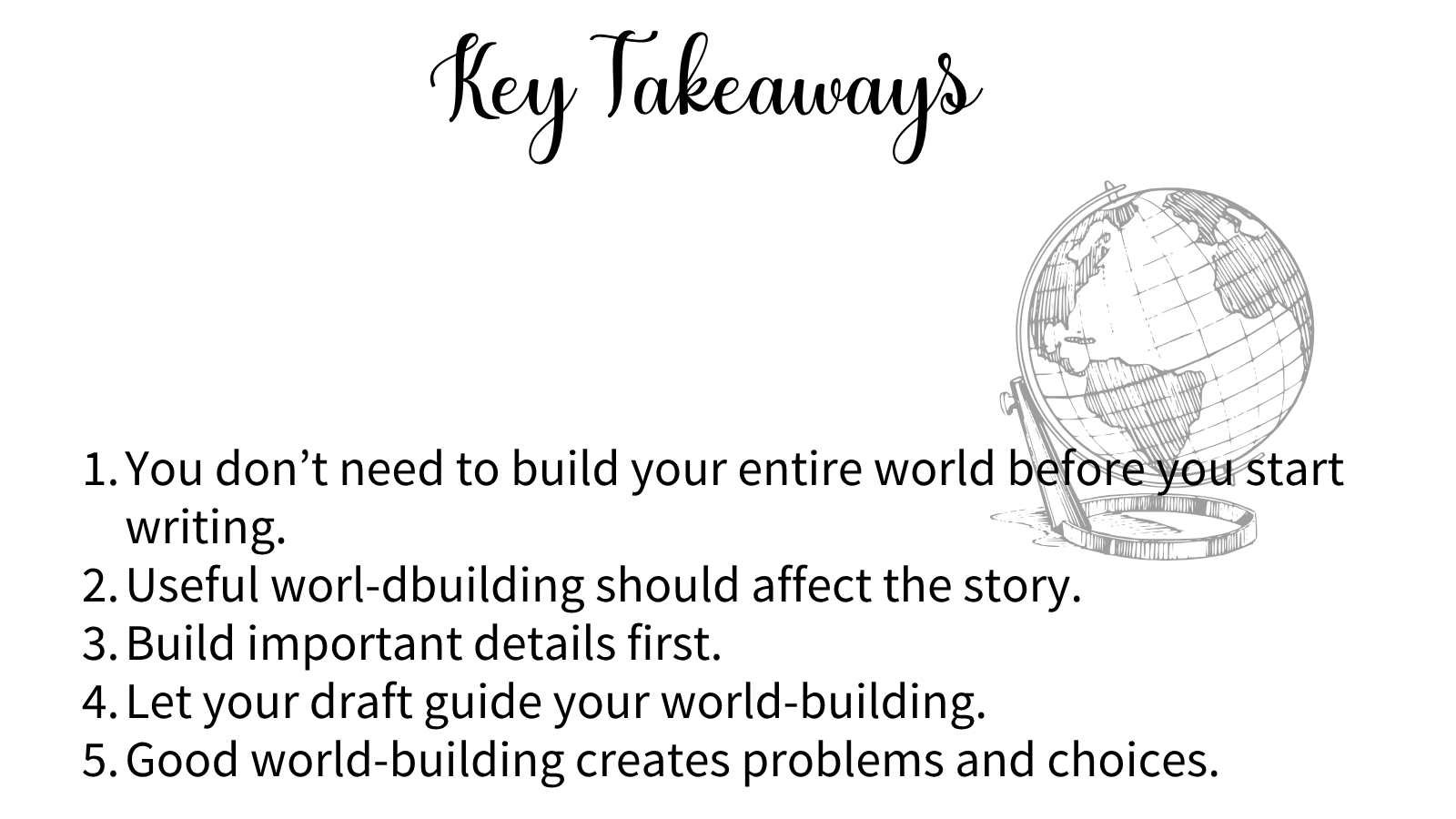
1. You don’t need to build your entire world before you start writing.
2. Useful worl-dbuilding should affect the story.
3. Build important details first.
4. Let your draft guide your world-building.
5. Good world-building creates problems and choices.
Last Words on the Only What You Need Method
You don’t need a complete fictional world before you start writing.
You need enough world for the next scene to work.
Start with:
♥ Rules
♥ Power
♥ Culture
♥ Conflict
♥ Setting
♥ Resources
So build the pieces that affect your characters but leave the rest alone until it matters.
Remember, your world does not have to be finished before the story begins. It only has to be finished enough for your characters to get into trouble.
In short, build the story, not the encyclopedia
Happy writing!
Linda
Liked this post? Pin this image! It’s a huge help for my blog. Thank you!
Feature Image from Pixabay
Frequently Asked Questions
1. How much worldbuilding do I need before I start writing?
Probably less than you think. You need enough to understand your main characters, the central conflict, the important locations, and any rules that directly affect the story. You can figure out the rest when the story starts asking questions.
2. What are the most important parts of worldbuilding?
Start with the pieces that create pressure on your characters.
Rules, Power, Culture, Conflict, Setting, Resources
Without going into details: Ask how each area affects what your characters can do, what they want, and what stands in their way.
If it matters to the story, build it.
If it does not, it can probably wait.
3. Can I start writing if my fictional world is not fully developed?
Yes. In fact, drafting is often one of the best ways to discover what you still need to know. You may reach a scene and suddenly realize you need to know how people travel, who enforces the law, how money works, or whether magic can heal a certain injury.
That is useful information. Answer the question the scene is asking, then keep going. You don’t need to solve problems the story has not given you yet.
4. How do I know if I am doing too much worldbuilding.
Worldbuilding becomes a problem when it starts replacing writing. If you know the names of twelve dead kings but still are not sure what your protagonist wants, it may be time to go back to the story.
5. Do all genres need worldbuilding?
Yes. Some genres make it more obvious than others. Fantasy, science fiction, and dystopian fiction often require invented rules, cultures, technology, or political systems.
But a contemporary romance still needs a believable world.
♥ Where do the characters work?
♥ Where do they live?
♥ Who do they spend time with?
♥ What does the community expect from them?
♥ What does everyday life look like?
♥ Worldbuilding is simply the process of making the place your characters live feel real.
6. How can I make worldbuilding feel natural instead of dumping information on the reader?
Let readers experience the world through the characters.
♥ Instead of explaining a law in a paragraph, show your character worrying about breaking it.
♥ Instead of describing an entire class system, show how two people from different classes are treated.
♥ Instead of explaining that food is scarce, show someone saving half their dinner for tomorrow.
Readers usually understand a world faster when they see how it affects the people living in it.
Don’t explain everything just show them what matters.


0 Comments