

Have you ever seen a sentence like “Let’s eat Grandma!” when someone really meant “Let’s eat, Grandma!”? This small comma mistake can lead to a funny but shocking message.
Punctuation might seem like a little detail, but it can change how people read and understand your words. In this blog post, we’ll take a quick tour of the most common punctuation marks. This is the first in a series where we’ll explore each mark in more detail.

Punctuation is the system of marks we use in writing to help readers understand how to read a sentence or passage. These marks—like periods, commas, question marks, and so on—tell us where to pause, stop, show emotion, or clarify meaning.

Related Reading: Understanding Subject Modifiers
Why Punctuation Matters?
Punctuation helps your writing make sense. Think of it like road signs for readers. It tells us when to pause, when to stop, and how to read a sentence. It guides our eyes and minds as we read.
Proper punctuation makes your writing clear and easy to understand. This helps people understand your ideas better. Without punctuation, sentences could become confusing.
Getting punctuation right depends on understanding the text, the bigger picture, and any extra facts.
♦ Example: The prisoner said the witness was a thief.
♦ Example:The prisoner, said the witness, was a thief.
Can you see how adding or removing commas switches the meaning, showing how vital punctuation can be.

Related Reading: How to Use Conditional Sentences
Two Systems: Close & Open
There are two main ways of punctuating:
Close (stiff) punctuation: putting in every possible punctuation mark. Common in laws, contracts, and formal documents.
Open (easy) punctuation: leaving out marks that aren’t absolutely needed. This is more common in everyday writing.
Writers now lean toward a more open style, but you still have to justify each comma or period you use.
Punctuation’s History
Early writing had no punctuation—just strings of letters. Over time, people introduced:
♦ Periods (dots) to separate thoughts or sentences.
♦ Slashes, colons, and semicolons in manuscripts, often placed differently than we do now.
♦ Spaces between words, which was a big step forward.
As printing became common, printers realized they needed a standard, organized way to punctuate. Scholars like Aldus Manutius helped shape these rules. Even the word “period” comes from a Greek term meaning “a division of a sentence.”
Over time, marks like commas, semicolons, and exclamation points gained specific uses. Some were adapted from older symbols, like the Greek semicolon (which was their question mark).
Common Punctuation Marks
Today, we use many standard marks: commas, semicolons, colons, periods, question marks, exclamation marks, parentheses, brackets, apostrophes, hyphens, dashes, and quotation marks.
Here is a brief look at the marks you’ll see the most:
Period (.)
A period marks the end of a sentence.
♦ Example: I walked the dog.
Comma (,)
A comma can separate items in a list or add a pause.
♦ Example: I bought apples, oranges, and bananas.
Question Mark (?)
A question mark ends a direct question.
♦ Example: Where are my keys?
Exclamation Point (!)
An exclamation point shows strong feeling like excitement or surprise
♦ Example: I can’t believe it!
Colon (:)
A colon introduces a list or an explanation.
♦ Example: I need three things: water, food, and shelter.
Semicolon (;)
A semicolon connects two independent but related sentences.
♦ Example: I like coffee; my best friend prefers tea.
Quotation Marks (“ ”)
Quotation marks enclose direct quotes or dialogue.
♦ Example: My mom said, “Please clean your room.”
Apostrophe (’)
An apostrophe shows possession or takes the place of missing letters in contractions.
♦ Example: Sarah’s book.
♦ Example: It’s raining.
Parentheses ( )
Paratheses add extra, non-essential information.
♦ Example: My dog (who is only a year old) is still very playful.
Dashes & Hyphens (-, —)
Hyphen (-) connects words like “well-known.”
An em dash (—) can set off a part of a sentence—like this—for extra emphasis.

Related Reading: Understanding Sentences, Phrases, and Clauses
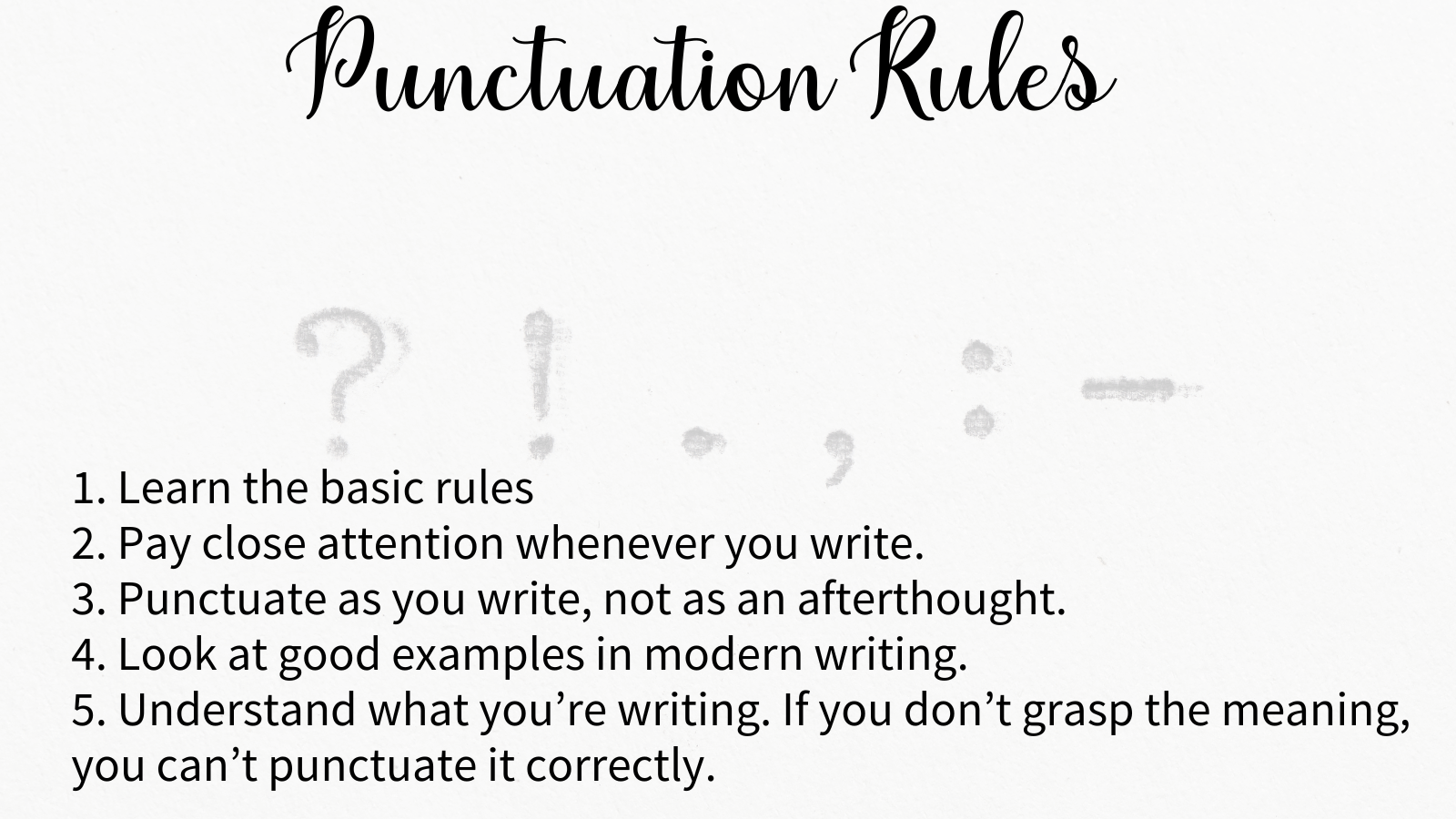
Punctuation Rules
Punctuation rules aren’t always perfect, however. Avoid applying them without careful consideration. To punctuate effectively, it’s crucial to:
1. Learn the basic rules
2. Pay close attention whenever you write.
3. Punctuate as you write, not as an afterthought.
4. Look at good examples in modern writing.
5. Understand what you’re writing. If you don’t grasp the meaning, you can’t punctuate it correctly.
Bonus Tip: Install ProWritingAid, and let the program help you with your punctuation. I am using it as I write this blog.
Key Takeaways
1. End Sentences Properly: Always end a complete statement with a period (.). This shows the reader your thought is finished.
2. Use Commas for Clarity: Commas (,) can separate items in a list or provide natural pauses.
3. Ask Questions with Question Marks: If your sentence is a question, use a question mark (?) so the reader knows you’re asking something.
4. Go Easy on Exclamation Points: Exclamation points (!) show strong emotion or excitement, but using them too often can make writing look unprofessional.
5. Connect Related Sentences with Semicolons: If you have two closely related sentences, you can link them with a semicolon (;). This prevents run-ons and keeps your writing smooth.

Last Words on Punctuation
Elliptical sentences can help us say more with fewer words. They add style and variety to our writing, as long as we use them carefully. Next time you notice someone leaving out words in a sentence, see if you can spot what’s missing.
Over the next few blog posts, we’ll explore each punctuation mark in detail. We’ll look at real-world examples, and you can practice with exercises.
Happy writing!
Linda

Liked this post? Pin this image! It’s a huge help for my blog. Thank you!
Feature Image by Becca Clark from Pixabay


0 Comments